Gone are the days when creative thinkers and marketers would spend hours putting their heads together to create a compelling ad campaign for a brand—one that had the potential to register in the user’s memory and drive faster conversion.
Fast forward to today, when advertising is no longer a guessing game—it’s a serious algorithm-driven strategy that learns, adapts, and optimizes in real time. With Google AI and automation taking center stage in the world of advertising, marketers are now compelled to rethink their strategies for creating, targeting, and scaling ad campaigns to stay competitive and relevant.
Here, we discuss the evolving future of advertising due to the emergence of Google Ads automation.
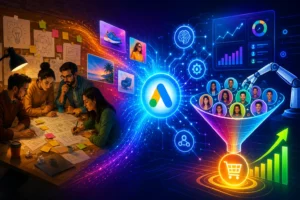
Google AI & Automation in Advertising: What it Means for Marketers
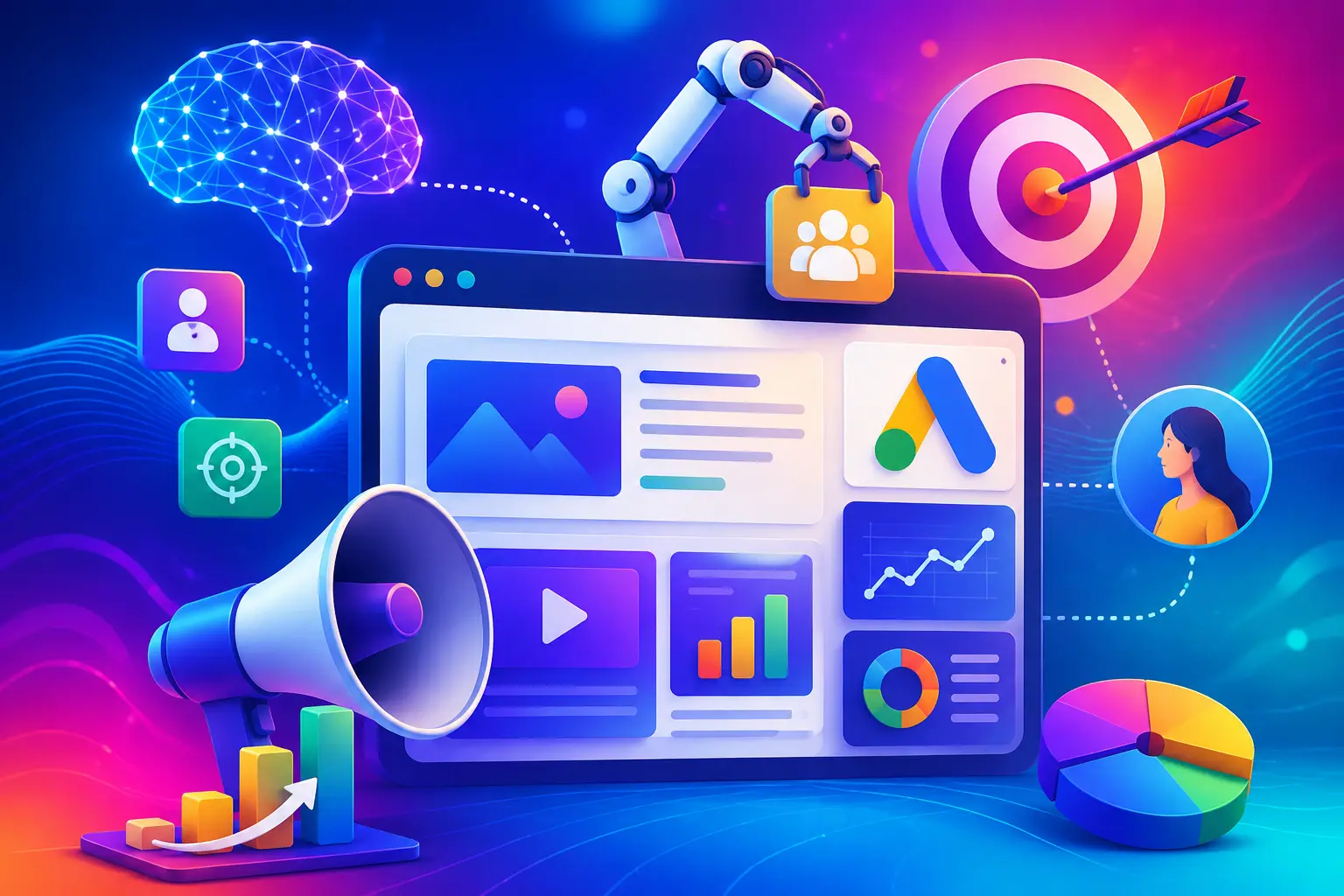
Google AI has entered the world of advertising and is propelling the use of data-driven ML algorithms to help automate and optimize ad campaigns, resulting in improved performance. It is transforming the entire way ads are created, targeted, and optimized, blending machine learning with automation.
This simply means that advertisers can now use data-driven systems to analyze user behavior patterns, predict outcomes, and make decisions in real time. They don’t need to depend on manual inputs anymore. Through features like Responsive Search Ads, Smart Bidding, and Performance Max, automation is helping businesses improve efficiency and results.
This shift from manual control to intelligent automation is now enabling marketers to focus more on creativity, strategy, and achieving overall campaign goals, rather than on daily optimizations.
Traditional Ads vs AI-Driven Ads: How They Differ
One of the key factors differentiating traditional ads from modern AI-driven campaigns is that the former were largely dependent on broad assumptions by creative designers and on manual decisions.
This approach is now being rapidly replaced by smarter, data-driven systems that deliver greater precision, speed, and continuous optimization in the ad design process, thereby fundamentally changing how campaigns are created, executed, and scaled.
|
Parameters |
Traditional Ads |
AI-Driven Ads |
| Bidding | Fixed or Manual | Automated and in real time |
| Optimization | Manual and regular updates | Automated, continuous updates |
| Performance Insights | Limited and in hindsight | Predictive and in real time |
| Targeting | Assumption-based and broad | Very precise; data-oriented |
| Ad Creation | Static creatives | Adaptive and dynamic |
Benefits of Google Ads Automation
Automation in Google Ads is helping marketers reshape their entire strategy of running ad campaigns. They are now smarter, faster, and more efficient thanks to AI features. As a result, businesses can now achieve high performance with greater precision and less manual effort.
Here are some more ways in which Google Ads automation helps benefit ad campaigns devised by marketers:
- Helps improve accuracy in targeting by making use of user intent data and audience signals
- Helps save considerable time by automating targeting, bidding, and ad optimization
- Helps scale ad campaigns seamlessly across diverse channels, platforms, and audiences
- Helps improve ROI for businesses via data-oriented, real-time decision-making processes
- Helps optimize ad campaigns continuously, facilitating improved performance
Challenges & Limitations of Google Ads Automation
Like two sides of the same coin, Google Ads automation not only brings about efficiency and a ton of other benefits to marketers but also presents a few challenges that are difficult to ignore. Understanding the limitations of automation tools and learning the ways to use AI more effectively to your advantage is key in this case. Here are some common challenges faced by marketers in using automation:
- Dependence on AI for making decisions lacks transparency. This makes it difficult for the marketers to understand changes in performance.
- Limited manual control over campaigns can make it difficult for marketers to fine-tune and add finishing touches to specific components to improve performance.
- Overdependence on automation can reduce the scope for strategic thinking and creativity.
- Limited or poor data may lead to inaccurate targeting and suboptimal results.
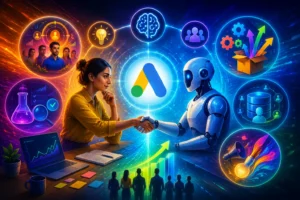
The Way Out: How Marketers Can Adapt to The Automation Shift
We understand the limitations, but what is the way out? The answer lies in the evolution of marketers from hands-on executors to strategic decision-makers. This shift is particularly important in the wake of AI reshaping the world of digital advertising.
Furthermore, you need to join hands with automation, utilizing its full potential, while not losing complete control over the campaign outcome by gently guiding it with human creativity and insight.
- Start making the inevitable shift away from manual execution tasks toward messaging, strategy, and understanding your target audience.
- Keep testing campaigns continuously to derive learnings from AI-generated insights.
- Keep yourself up to date on the latest tools and features in Google Ads.
- Make efforts to invest in first-party data for improved AI-oriented targeting and performance.
- Ensure that you balance out automation with human creativity to maintain brand voice.
The Way Forward: Google AI and the Future of Advertising
Once marketers successfully find their way out and adapt to evolving Google Ads automation trends, it’s time to look ahead and focus on reshaping the future of advertising with smarter algorithms that can forecast, personalize, and scale like never before.
With AI-driven Google Ads, ad campaigns are expected to become more automated, intuitive, and outcome-focused. Here are some key trends to note in the future:
- There may be increased adoption of fully automated campaign types such as Performance Max.
- Hyper-personalized ads customized to individual user intent and behavior will be created.
- There will be more focus on first-party data usage and privacy-first strategies.
- Increased dependency on predictive analytics for campaign planning and optimization will be observed.
- Brands will enjoy seamless cross-channel advertising across platforms such as Display, Search, and YouTube.
Final Thoughts
Google AI and automation are now redefining the world of advertising like never before. Success in the field largely depends on how well businesses can strategize, adapt, and effectively adopt AI-driven tools to their advantage.
Straction Consulting can help brands like you navigate this inevitable shift with expert campaign management strategies and data-oriented approaches. Our Paid Search services perfectly combine human creativity with AI efficiency, ensuring every campaign of yours delivers measurable impact. For more information, do get in touch on 9810430573 to speak to one of our experts on how we can help.