
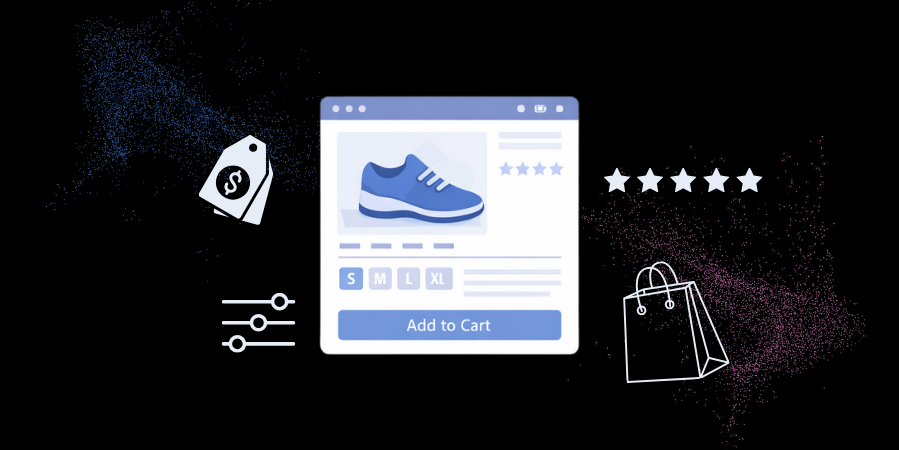
Ever clicked a filter and ended up on the same page again (or at least what feels like the same)? This isn’t an illusion, and you aren’t alone in experiencing it. If it makes you feel any better, Google also goes through the mess of duplicate content created behind the scenes by product variations and filters that are apparently put in place to make the e-commerce shopping experience seamless for users.
This blog discusses in detail how product variations and filters can boost the user experience but can silently wreak havoc on your SEO by creating duplicate content. We also share a few helpful tips on keeping your e-commerce store user-friendly, flexible, and perfectly SEO-clean.
Understanding Product Variations and Product Filters
Before jumping into fixing the duplicate content issue, it helps to identify the root cause. This is where knowing a brief background on product variations and filters comes in handy.
What are Product Variations?
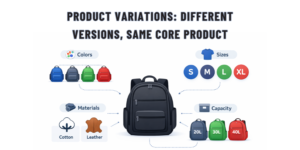
Product variations are the different versions of the same key product in your store. All of these versions share a common goal; however, their differences lie in their specific traits.
- All variations of the core product are generally available under a single key product listing.
- Common variations typically include color, size, material, and storage methods.
- Users tend to choose product variations in which the core identity of the primary product remains unchanged.
Expert Insight: Product variations improve and enhance user choice, not search visibility. If the search intent is the same, a sound SEO approach is to create a single canonical product page to avoid duplicate content and dilution of SEO.
What are Product Filters?
Product filters are interactive navigation tools that let shoppers sort and narrow product listings without changing the core product offering.
- Common product filters include brand, price range, discounts, availability, and ratings.
- Filters are implemented to enhance the overall user experience (UX) by enabling easier browsing of extensive catalogs.
- Mismanagement of filters → result → generation of multiple URLs and duplicate content.
Expert Insight: Unless product filters can create an apparent search demand and user intent, consider them as UX tools and not SEO pages.
Why Search Engines Treat Product Variations and Product Filters Differently
The primary aim of search engines is to rank unique value showcased by a website, not repetitive layouts with minor tweaks. The reason for the different treatment is thus apparent:
- Product variations generally represent the same core product and are designed to build authority.
- Since product filters do not add any unique content, indexing them may result in a drop in rankings.
Expert Insight: Search engines treat product variations and product filters differently because each affects content uniqueness and crawl efficiency.
Also Read: Best Practices for Brands to Leverage the E-Commerce Marketplace Opportunity
How Duplicate Content is Created in E-Commerce Stores
Content duplication in e-commerce stores occurs when multiple URLs display the same or similar information about a core product, which can be highly confusing for both users and search engines. Moreover, it can negatively impact rankings, too.
Here are some ways in which duplicate content is created:
- Sorted or filtered pages that generate highly similar or duplicate content.
- Manufacturer descriptions are reused across several product listings.
- Multiple URLs are generated for the same core product owing to variations in color, size, or style.
Expert Insight: Duplicate content in e-commerce websites often arises from multiple URLs, reused product descriptions, and filters. They end up confusing search engines and users and diluting the site’s SEO value.

Best Practices for Handling Product Variations
The key is to manage product variations effectively to ensure your website remains SEO-friendly and continues to offer a hassle-free shopping experience for users. Here are some best practices that can help prevent the issue of content duplication and enable search engines to understand your product catalog better:
- Implement structured data: Make sure to highlight product variations such as color, size, or price in schema markup for improved search visibility.
- Use canonical tags: Direct all variant URLs to the main product page.
- Reduce the number of crawlable variations: Whenever possible, avoid indexing every variation. Instead, focus on high-value variations to help maintain SEO strength.
Expert Insight: Manage your product variations well using structured data, canonical tags, and selective indexing to improve user experience and maintain the SEO value of your site.
Best Practices to Manage Product Filters Without Damaging SEO
One of the best ways to improve the user experience without significantly harming your website’s SEO is to optimize product filters.
- Use canonical URLs for filtered pages.
- Prevent search engines from indexing pages that add very little SEO value to the website.
- Concentrate on high-priority filters to drive traffic and subsequent conversions.
Expert Insight: Use product filters to guide users and not search engines. Ensure only filter pages with an apparent search intent are crawled and indexed.
Product Variations vs Product Filters – Key Differences
It is critical to understand the differences between Product Variations and Product Filters. Mixing up the two can often result in content duplication, over-indexing, and wasted crawling budget.
| Parameters | Product Variations | Product Filters |
| Objective | Display different versions of the same product | Allow users to narrow down product listings |
| SEO Intent | Consolidated into one single page | Generally navigational, can’t be indexed |
| Indexing Strategy | Canonicalized or indexed selectively | No-index or restricted |
| URL Behavior | Can share only one canonical URL | Can generate multiple parameter URLs |
| Examples | Color, model, size, storage | Brand, availability, price, rating |
Common Mistakes to Avoid When Handling Product Variations and Product Filters
A few simple mistakes can turn product variations and product filters into major SEO issues. It is therefore essential to be aware of these mistakes to protect your site’s rankings and keep it crawl-efficient.
- Incorrect canonical loops: They simply confuse search engines by directing pages to each other rather than to a clear primary URL. This further weakens page indexing.
- Indexing every possible filter combination: You can end up creating countless pages with less value, thus diluting the SEO authority of your website and wasting budget for crawling.
- Ignoring internal linking signals: This would send mixed signals to search engines and make it harder for them to identify and prioritize your website’s most important pages.
- Relying solely on plugins without a clear strategy: This approach can lead to inconsistent SEO signals and leave content issues unresolved despite technical fixes.
- Blocking important pages in robots.txt prevents search engines from crawling them and ranking them, even though they are SEO-optimized.
Also Read: Ecommerce SEO Trends: Survival Guide for D2C Brands
Final Thoughts
Handling product variations and product filters is not about limiting your choices; it’s about directing them wisely by finely balancing User Experience and SEO. By aligning user-friendly navigation with a search-friendly site structure, you not only avoid content duplication issues but also protect your site’s rankings from dipping.
Need help getting this balance right? Leave it to experts like Straction Consulting, one of the best digital marketing agencies in Noida. We help remove confusion from product variations and filters with a clear, coherent, and SEO-first strategy.
Giving your site a cleaner structure and improved crawl efficiency, Straction Consulting helps improve your rankings on search engines while ensuring a seamless shopping experience for your customers, too – a complete win-win! Speak to our experts at 9810430573 today to learn more about how we can help.