Today, getting started with a website is like child’s play, especially with hosts that offer free subdomains where you can set up your website within seconds, and that too without spending any money. However, the real challenge is achieving a high search engine ranking through SEO. Does Google treat free subdomains the same way as full-fledged websites, or do they have any disadvantages?
Many beginners try to build domain authority with these subdomains, but later find that most of the credibility and control associated with them are limited. While free subdomains can be a way to begin building a web presence, there are downsides to using a subdomain compared to a full website, which most users realize later. By gaining insight into how Google views subdomains and websites, you can help avoid free subdomain SEO challenges that could impact your ability to rank properly in search engines and future-proof your SEO strategies with long-term decisions.
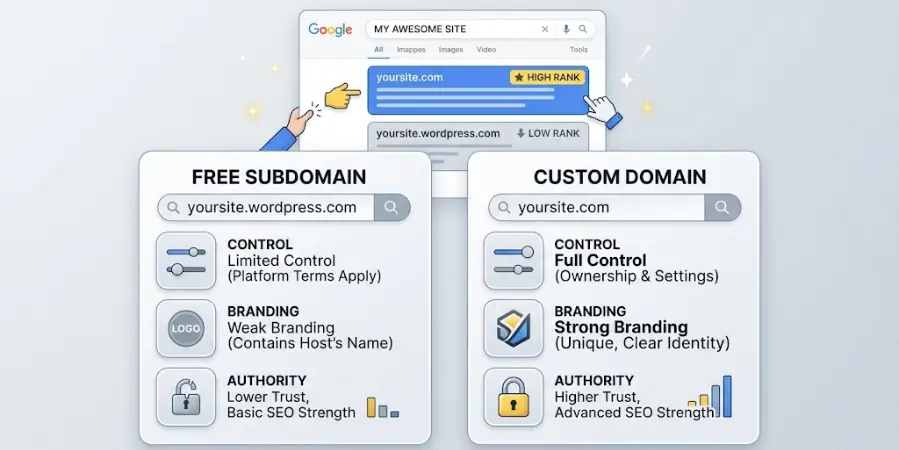
What Are Free Subdomains and Why Do They Matter for SEO?
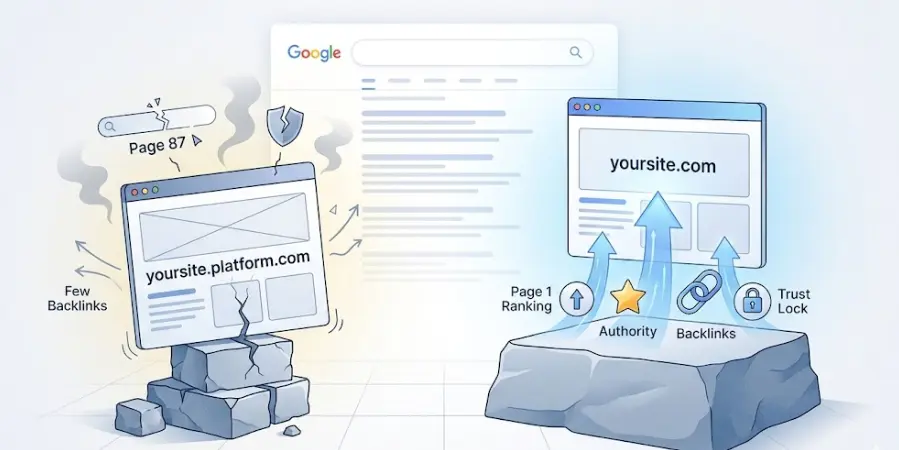
A subdomain is a URL (Universal Resource Locator) for a web page you create using free website hosting. When you create a free domain to host a website, the URL will use the Host’s base domain rather than your custom domain. For example, if you register your website through your host, instead of yourwebsite.com, your site would appear as yourwebsite.platformname.com. Many of the popular web hosts offer free subdomains. The most commonly used ones are WordPress.com, Blogger.com, and Wix.
Why Free Subdomains are Useful for SEO
Free subdomains can benefit beginners, students, bloggers, and those working on small projects by providing an easy-to-use homepage at no cost. However, from an SEO perspective, free subdomains are limited, as users have less control over domain authority, branding, and the technical aspects of optimizing the website for SEO than if they registered and created their own domain.
Search engines may treat the free subdomain as a separate website, requiring website owners to build their own authority and credibility through independent SEO. A free subdomain can help new/start-up websites and those looking to test an idea by providing an extremely low-cost way to launch a website. If your website is expected to be a serious business, has long-term brand-building potential, and you are looking to rank it competitively in search engines, then it is a good fit. Free subdomains are not the right option for you.
Key SEO Challenges of Free Subdomains
From Google’s perspective, using free subdomain hosting poses significant, long-term SEO challenges rather than technical penalties. According to Google, while these platforms are not automatically penalized, they are inherently difficult to rank because of shared reputation risks, lack of ownership, and difficulty establishing trust with search engines.
Below are some key SEO challenges that you can experience with free subdomains:
1. Limitations on Domain Authority (DA)
Having a free subdomain means not owning the main domain. Most of the site’s authority and trust signals are tied to the parent domain, not to an individual subdomain, making it difficult to build long-term SEO authority, since you are building your website on your own property but under someone else’s domain.
2. Brand and User Trusts
Users tend to trust a custom domain more than a free subdomain, as it looks more credible and professional. Since they are often viewed as temporary or untrustworthy by users, a free subdomain can lack user trust, leading to lower CTR (click-through rates) for your site, even if your page is near the top of search results.
3. Inaccessibility of Technical SEO
Platforms offering free subdomains often restrict the use of technical SEO features such as robots.txt files, structured data, advanced redirects, and server-level optimizations, which could prevent your website from being fully optimized for search engines. In some situations, how well your page performs on the internet and its speed depend on the platform’s infrastructure, not necessarily on your own optimizations.
4. Limitations of Backlinks
Building backlinks to a free subdomain means some of the authority benefits will go to the main platform’s domain instead of your subdomain. This will make it tough for you to compete with other sites that have their own domains and full control over their backlink profiles and domain authority growth.
5. Risks of Platform Dependency
Being on a free subdomain places you in complete dependence on the platform’s rules and policies. If the platform changes its criteria or policies, shuts down, or blocks your content, your website could be suspended or deleted. This creates a significant long-term risk because you don’t own or control the site.
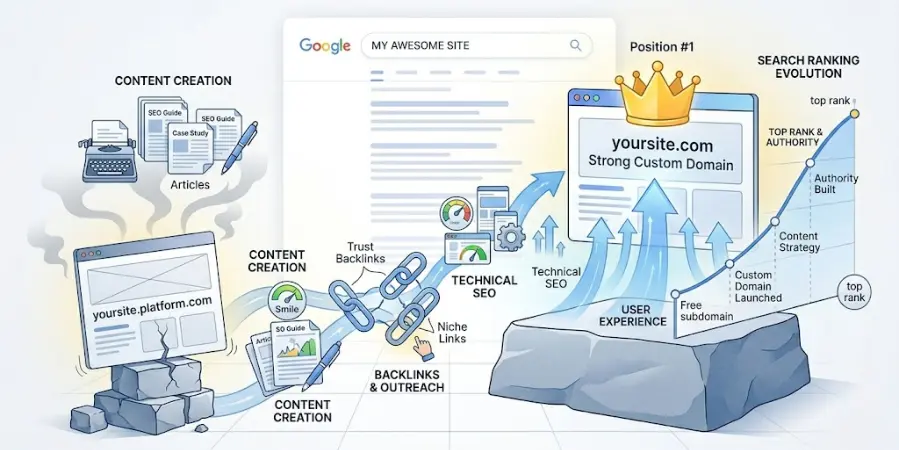
How to Overcome Free Subdomain SEO Challenges
While subdomains may allow you to create a website quickly, they have significant SEO drawbacks that will impede your site’s long-term success and ranking. The limits on domain authority, as well as the technical restrictions of using a free subdomain, will make it even more difficult to compete with websites that have their own custom domains. You must understand these limitations if you want to continue growing your site, establishing its authority, and improving its visibility in search results over time. Here are some key limitations to consider:
- Concentrate on Publishing Great Content: Start by creating high-quality, original, and helpful content to build authority and rank well in search over time.
- Search Engine Optimization (On-Page): Improve the visibility of your site with the appropriate title tags, Meta descriptions, headings, internal links, and keyword optimization in order to rank well in searches.
- Quality Backlinks: Try to earn backlinks through guest posting, directories, collaborations with other sites, and create shareable content to boost your authority.
- User Experience: Ensure that your website loads quickly, is easy to navigate, and is mobile-friendly, so that your users have a good experience, engage with your content, and see better SEO results.
- Custom Domain: You can use a free subdomain to learn and test in the initial stage of starting a website. Later, you can migrate to a custom domain once your website grows to build long-term SEO authority and branding.
Takeaway
If you are just starting and want to launch a website quickly with little or no money, consider using free subdomains. Free subdomains allow you to gain valuable hands-on experience launching a website and marketing your content online.
Moving from free subdomains to a custom domain is an important decision that can help make a site successful. A custom domain gives you complete control of your website, helps you build a solid, long-lasting brand, and improves your website’s long-term SEO. Moving from a free subdomain to your own website domain is one of the most important milestones in developing your online presence. Here, Straction Consulting, one of the best SEO-focused digital marketing agencies, helps businesses achieve high-quality, SEO-optimized content aligned with your overall business goals. For more details, call us on +91 9810430573.