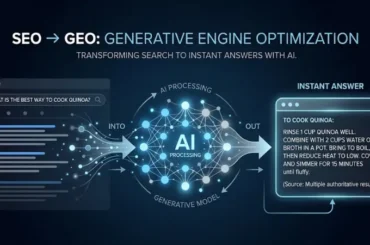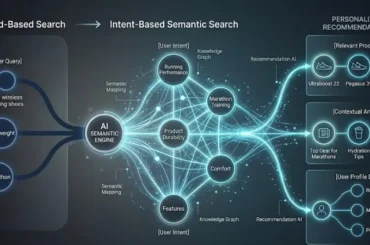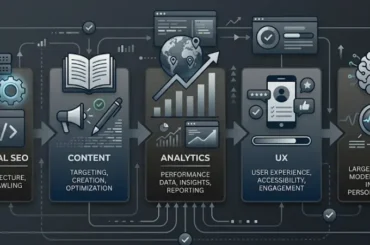

The thing with Search Engine Optimization (SEO) is that it never stands still. Artificial intelligence (AI) is reshaping how people find answers and how search engines deliver results. As such, marketers must continually update their strategies to stay online. Gone are the days when backlinks and keyword stuffing were the only ways to get organic traffic.
Search engines these days prioritize meaning, experience, trust, and context. They frequently deliver these directly in search results, so users do not even have to click through.
Let’s dive into the top Google algorithm trends and signals that marketers must keep track of in 2026 and beyond.
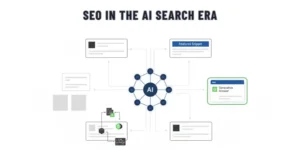
The Big Picture: SEO in an AI-Powered Search Landscape
Search engines these days are not limited to indexing pages – now they understand intent and meaning as well!
- AI technologies, such as large language model search platforms like ChatGPT, Gemini, and Perplexity, and Google’s Search Generative Experience, are changing how search results are presented and crafted.
- These systems generate and synthesize responses that answer queries straight away on the search page itself.
- This implies that ranking at the top of the conventional search engine results page (SERP) no longer guarantees clicks, as users can now get answers without scrolling.
- This has led to two connected trends reshaping SEO: answer engine optimization and generative engine optimization.
- Answer engine optimization is the process of optimizing content not only to rank but also to be cited in AI-generated answers.
- Generative engine optimization is the process of tailoring content so it can be discovered and considered an authoritative source by AI-driven systems.
1. Zero-Click Search Trends and AI Overviews
When you think of the latest Google algorithm trends, this is the first one that comes to mind.
- AI overviews, which are synthesized and brief answers generated by AI in search results, are becoming increasingly important.
- These appear at the top of the SERPs and frequently satisfy users’ queries without the traditional clicks.
- This matters because the top organic click-through rate (CTR) may drop significantly when users get answers without clicking.
- Marketers must prioritize capturing featured snippets, structured answers, and frequently asked questions (FAQs) to remain visible.
- Your content must be concise, structured, and helpful, rather than optimized solely for keywords.
- Use schema markup, such as the QAPage and FAQPage schemas, and create concise, clear responses to common user questions to improve your chances of appearing in AI responses.
2. E-E-A-T: Experience, Expertise, Authority & Trustworthiness
Google’s algorithms continue to reward high-class content, which shows trust and provides a real human experience.
- Algorithm updates focus on user-centric quality signals like experience, E-E-A-T, and firsthand knowledge.
- Such a trend indicates a mature search ecosystem in which generic, superficial, and thin content is deprioritized.
- Personal experience, accurate information, and unique insights have now become more critical than ever.
- Outbound citations, credentials, author profiles, and links from authoritative sources are now essential.
- The best practices here start with including author credentials and bylines on content pages.
- Marketers must also use outbound links to trusted sources, along with internal linking, to contextualize information.
Additionally, they must update content regularly to reflect the latest trends and information.
3. Voice and Conversational Search Optimization
Voice search via intelligent assistants such as Google Assistant, Alexa, and Siri is becoming increasingly popular.
Voice queries are usually more conversational and longer than typed keywords. This pushes SEO toward phrases that match natural speech patterns.
You may be wondering how conversational search differs. Well, here, queries are question-based. For example, instead of saying “SEO ranking tips,” users here will say “How can I improve my site’s SEO rankings?”
Also, users expect direct and quick answers. Voice search optimization also overlaps a lot with AI optimization. To do this, create FAQ pages that answer specific questions in a conversational tone, and use question formats and long-tail keywords throughout your content.
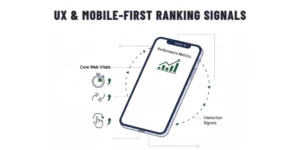
4. User Experience (UX)-Centric and Mobile-First Ranking Signals
Google’s algorithm prioritizes mobile versions of websites. This is especially true, as most global searches now occur on mobile devices.
- Core Web Vitals, such as loading speed, layout stability, and interactivity, are critical ranking signals that reflect the user experience on your website.
- In this context, you need to improve your web page load times by leveraging caching, optimizing images, eliminating intrusive mobile pop-ups, and ensuring layouts are responsive across devices.
5. Content Format and Structured Data Signals
Schema markup, or structured data, helps search engines understand what your content is about.
- This has become even more important now in the era of generative AI search.
- Structural data formats enable rich results, including FAQs, knowledge panels, how-to queries, and carousel results.
- Proper markup increases the likelihood that AI assistants and search engines will surface your content in featured snippets and AI overviews.
6. Multimedia & Social Signals Enter the SEO Mix
Search engines are now not limited to indexing just text – they can also index social media content like public Instagram posts, hashtags, and captions, along with other metadata.
- Most importantly, video content – especially on YouTube – continues to play a role as one of the most significant search engines. Google is fusing video, text, and image in its SERPs.
- This means that video optimization, like titles, descriptions, and captions, enhances organic visibility, YouTube presence boosts overall search visibility, and image optimization using captions and alt texts has become more critical than ever.
7. Hyper-Local and Local Signals
As AI and voice assistants become more prominent, local search has outgrown conventional “near me” queries.
- Local relevance now depends on factors such as business profiles, hyperlocal keywords, and updated reviews and local listings.
- Marketers must ensure their local SEO is accurate, up to date, and optimized to capture conversational and mobile searches.
8. Beyond Google: Diversifying Visibility Platforms
Traditional Google SEO remains essential, but more users are turning to alternative discovery engines, such as Perplexity, ChatGPT, and other generative platforms.
- So, optimizing solely for Google is no longer sufficient.
- Marketers must track mentions and visibility across AI search platforms, create content aligned with AI-powered ranking preferences, and monitor performance on non-traditional search channels.
9. Continuous Optimization & Content Freshness
Algorithm trends indicate that regularly updated, fresh content often outranks outdated, static pages. This is especially true for dynamic topics.
- Stale content tends to become irrelevant quickly as search intents evolve, AI engines prioritize accuracy, and competitors uncover new insights.
- To do this, you can establish a content update schedule, such as quarterly.
- This is especially necessary for the high-performing pages.
Conclusion: Navigating the SEO Pulse with Straction Consulting
Keeping up with the ever-shifting search signals and algorithmic trends is not easy. However, for sustained growth and visibility, it is necessary. Contemporary SEO requires an adaptive, strategic approach, and the most important tools include AI-powered search, voice optimization, structured answers, and UX-focused ranking factors, to name a few.
This is where we at Straction Consulting come in. We assist you in decoding the newest algorithm shifts, strengthen your user experience signals, optimize your content for both AI and traditional search, and future-proof your website for long-term success. Our hands-on guidance will ensure that your site does more than keep pace. It will thrive in the ever-evolving search landscape.