

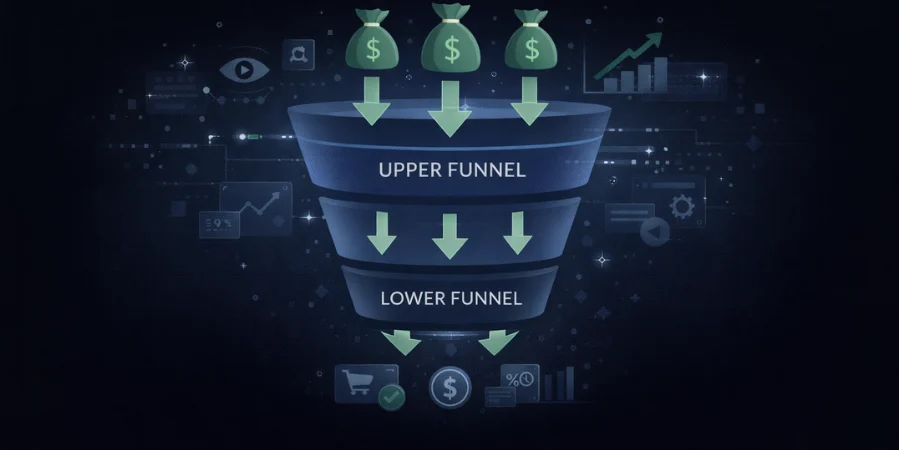
In paid media, separating the budget between the upper and lower funnel is a recurring topic. Upper funnel campaigns (usually awareness campaigns) create future demand; lower funnel campaigns (driving action) take advantage of existing demand. Where to place the budget is a skill and requires you to understand incrementality, along with the need for balancing immediate efficiency with a long-term creation of future demand.
Maximizing your return on investment from your paid media budget requires efficient allocation. While lower-funnel campaigns drive conversions, upper-funnel campaigns build brand equity, educate potential customers about your product/service, and drive long-term growth. Finding that equilibrium is essential for sustainable growth. In this blog, let’s discuss the upper funnel marketing budget and why it needs your attention and how much.
Understanding Upper-Funnel Marketing
Top of funnel marketing, also known as upper-funnel marketing, encompasses the objective of generating awareness, interest, and desire for a product or service. At this stage, you are educating potential customers on your brand and positioning yourself as the best solution to their problems.
The buying funnel is the method of classification that identifies what stage a prospective customer is in the process of purchasing, or whether or not they are familiar with your business. The top of the funnel is populated by potential customers who have identified that they have a problem and need to find a solution. However, they do not currently know about your business or how it can assist them.
Why Upper-Funnel Investment Matters
Upper funnel investment is important because it feeds into the complete sales pipeline. Failing to invest in this stage will deplete the audience you are marketing to, decrease your market share, and make acquiring new customers more costly in the future. Bottom funnel investments generate immediate or short-term conversions, but upper funnel funding supports long term growth through the introduction of new customers to your brand building credibility.
Factors Influencing Upper-Funnel Budget Allocation
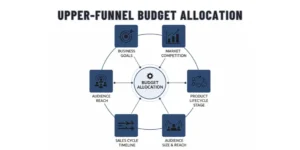
- Market Position/Goals of Business: A company looking to create/build its brand will spend more money on advertising or “upper-funnel” than a business that is primarily focused on making sales today.
- Market Maturity Level: New markets or very competitive markets generally require higher spending to create or grow a brand’s visibility in the marketplace than old/established markets.
- Stage in Product Life Cycle: Launching a new product requires more “upper-funnel” spending to establish a brand than an established product.
- Target Audience Population: In cases with a larger, undefined target audience, broader marketing will require a larger “upper-funnel” budget.
- Length of Sales Cycle: Products that have longer sales cycles will benefit from having exposure to your product at the “upper-funnel” over time because it helps nurture prospects.
Common Budgeting Approaches
- Percentage-Based Allocation: According to the growth objectives of your company, designate 20-40% of your total spending for marketing to upper funnel marketing efforts.
- Funnel Stages: Allocation of the total spend for each funnel stage based upon its share of driving conversions.
- Budgeting by Objective: Allocating the budget for upper funnel activity based upon specific objectives like brand awareness, reach, and engagement.
- Testing and Learning: Beginning with small expenditures on upper funnel activities and increasing as data shows what types of activities work best.
- Time-based or project-specific: Upper funnel expenditures increase during periods of product launches, seasonal periods, or company-wide expansion, such as the holidays.
Evaluating Effectiveness at the Upper Funnel
Success in the upper funnel can be gauged based on awareness and engagement metrics, not just through direct conversions. Impressions and reach are key indicators of how widely your brand is being seen. Engagement metrics (likes, shares, video views/number of times people interact with a video), show what interests your audience, and view-through conversions help you track users who convert after seeing an ad. To accurately assess the true impact of your campaigns, you need to connect your upper-funnel campaigns to lower-funnel performance metrics by looking at assisted conversions, conducting lift studies (a study done to measure the effectiveness of a marketing campaign), tracking branded search volume growth, and measuring the retargeting pool quality.
Tips for Maximising Upper Funnel Spend
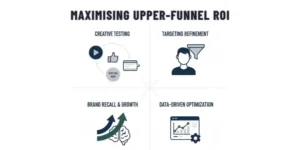
To get the most out of your upper-funnel budgets, it is important to test multiple creative formats and platforms (e.g., video, social, native, and display ads) to see which formats resonate with your audience. This will help you determine where to allocate your upper-funnel budgets with confidence based on data-driven insights (e.g., performance trends, audience signals, attribution data). Most importantly, ensure you are maintaining a balance between short-term ROI and long-term brand equity through consistent visibility while still providing support to conversion activity further down in your sales funnel.
Below are some tips for Maximising Upper-Funnel Spend:
- Concentrate on high-impact advertisements that communicate a definitive brand narrative.
- Develop brand recall by prioritizing reach and frequency.
- Multiple platforms and advertising styles should be tested to identify which will be scalable.
- Utilise audience knowledge to enhance targeting and eliminate unnecessary spending.
- Reconciling the objectives of the awareness with a measure of enduring success.
Conclusion
Putting money into the upper funnel is crucial for long-term success. Lower-funnel campaigns focus on getting immediate sales through immediate sales revenue, whereas upper-funnel campaigns focus on building name recognition and supporting additional sales later. Therefore, aim to create a balanced approach to allocating funds across these two areas based on your company’s objectives and target audience within your particular marketplace.
