In today’s world, user experience is the key driver of the modern web, and JavaScript is essential for creating quick, engaging interfaces. However, JavaScript’s interaction with search engines has changed in recent years. JavaScript SEO 2026-27 will no longer focus on whether Google can render JavaScript but on how well content is found, indexed, and presented across traditional and AI-powered search engines. Although Google’s treatment of JavaScript continues to improve, numerous crawlers and AI-based systems still have difficulty interacting with pages that include a large amount of JavaScript. Therefore, it is crucial to implement brilliant rendering, deliver content, and use the best search engine optimization practices so these pages are visible.
In 2026-27, JavaScript (JS) SEO is likely to mature from a hack used to fix hidden content to a sophisticated rendering strategy focused on performance, AI readiness, and user experience. Googlebot is now very proficient at rendering JavaScript, but it still experiences delays due to the two-phase indexing process, which first crawls the HTML and then renders the JavaScript. Let’s understand the key trends and strategies of JavaScript SEO in 2026-27 in this article.
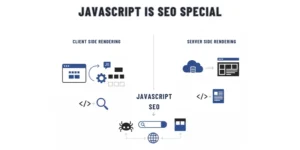
Why is JavaScript SEO Special?
Client-side rendering (CSR) is the process of generating dynamic HTML in the browser using JavaScript. The term “client-side” refers to JavaScript running on the client device (the browser) to render (process and display) the page’s content on the user device. On the other hand, server-side rendering generates pre-rendered HTML on the server for the browser, meaning everything is generated before delivery to the user and is therefore easier for tools that do not use JavaScript to determine what to display.
What’s Changed: 2026-2027 Trends
- Artificial Intelligence (AI) Overviews (AIO) and Generation Engine Optimization (GEO) will become the new Search Engine Optimization (SEO). No longer is it about links showing up in the blue area of the page; search engines like Google AIO, Chat GPT, and Perplexity are now reading your site and synthesizing your answers from that content. If your content uses client-side JavaScript for rendering, the AI bots won’t be able to interpret it.
- The Interaction to Next Paint (INP) will be a significant factor in the Search Engine Results Page (SERP). Google has updated its core web vitals and replaced FID/First Input Delay with INP. This means that sites that use substantial amounts of JavaScript will soon face penalties due to the lag introduced during user interactions (clicks, key presses).
- The shift towards Server Side Rendering (SSR) is now considered the industry standard, given the final nature of the latest frameworks and application development. The “Framework Wars” are over. Next.js, Nuxt.js, and SvelteKit have set the stage for standard solutions – SSR and hybrid renderings (Static -> Dynamic) – being utilized, whereas previously CSR would be implemented by default.
- The latest trend in modern application development is to eliminate “bloat” from the application development cycle and rely on the bare minimum components, including Jackson and lightweight libraries, to enable the use of native browser APIs.
- Rendering is performed more frequently in the CDN or at an edge location closest to the endpoint/user, thereby speeding data transfer and reducing overall latency.
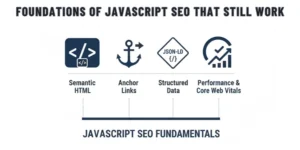
What Still Works: Fundamental Principles
Here’s what still works:
- Critical Content and Choice of SSR or SSG: To enable search engines like Google to index content quickly, SSR (Server-Side Rendering) and SSG (Static Site Generation) are the most effective approaches.
- Semantic HTML over Div Elements: Google indexes content based on semantic structure (e.g., articles, navigation, headers), rather than generic markup (e.g., div/span) styled with CSS alone (e.g., JavaScript).
- Using Standard <A> Tags As Internal Links: Google’s crawlers do not rely on JavaScript-generated links for discovery. Hence, the use of traditional anchor tags with href attributes is critical for SEO.
- JSON-LD Structured Data: As AI-based searches grow, using structured data (JSON-LD) will help search engines better understand the content provided.
- Performance Budgeting: Keeping track of how much JavaScript is sent to the browser helps to ensure that the Core Web Vitals (LCP & FID) remain in “good” standing.
JavaScript SEO Strategy for 2026-2027
Your website must have an Effective Hybrid Approach with Proactive Rendering.
- Use Islands Architecture: Use React and other frameworks (e.g., Astro) to create a page that is primarily rendered as Static HTML, with the only JS and/or interactive elements “hy-draised” or converted into interactive components.
- AIO is Optimized for Visibility: Ensure the core content of your page appears in the raw HTML returned with your web page. The core content of the page (your “answer”) should be available to the visitor in the first two or three seconds of the page loading (not after a lengthy loader graphic).
- Asynchronous and Deferred Loading of Script Files: If you are using third-party tracking script files, they should be loaded asynchronously, so they do not prevent your core content from rendering.
- Canonical URLs Must Be Updated Properly: When your user is navigating through your site, the JavaScript Router should be dynamically updating the Canonical URL to notify Google that the two pages currently being viewed (one in the navigator and one in your Canonical URL) have their own Canonical URL.
- Regularly Test Raw/Rendered Pages with GSC’s Rendering Tool: Use the URL Inspection Tool in your Google Search Console on a regular basis to compare the Raw HTML with the Rendered Version. If the rendered page does not contain the same information, your SEO will be adversely affected.
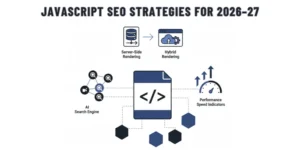
Key Strategies for 2026-2027
Below are the key strategies to consider for 2026:
- Use Frameworks with Built-in SSR: Choose a framework such as Next.js, Nuxt.js, or SvelteKit to handle SEO optimization for you.
- Optimize for INP Interactivity: Break up long JS tasks into smaller chunks by using a scheduler. yield() method to keep users from feeling like their pages have become unresponsive due to long waits for script execution.
- Use New Image Formats to Improve Page Performance: Use AVIF or WebP image files with the native lazy-loading attribute (loading=”lazy”) for improved performance on your pages.
- Use Islands Architecture: Use an “islands” architecture strategy with a framework like Astro to ship as little JavaScript as possible, focusing on rendering only interactive elements rather than the entire page.
- Use RUM Monitoring to Assess Actual User Experiences of Your JavaScript: Use RUM (real user monitoring) instead of synthetic monitoring.
Takeaway
JavaScript SEO, 2026 is about striking the right balance between delivering an excellent user experience and improving visibility. The key is to focus on Server-Side Rendered (SSR) pages, performance-focused JavaScript applications, and AI-friendly content delivery to remain discoverable in both search engines and AI-driven platforms through 2026/27 for best results.