
Curious whether Google still favors human-written content in an age flooded with AI-generated text? Although an increasing share of web pages include AI content, recent SEO studies indicate that nearly 83% of top-ranking pages still rely on deep, expert-led insights. As we approach 2026, Google’s content evaluation and ranking continue to shift, combining classic SEO principles with new AI-readability tests. In this post, you’ll gain clarity on what works, what doesn’t, and how to balance AI and human craft so your content rises above in search results-and stays there.
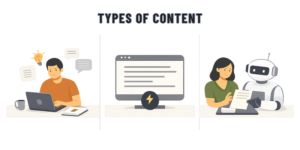
Understanding Different Content Types
Before reviewing performance, it’s essential to define each content type.
1. Human-Written Content
- Created entirely by an experienced writer
- Manual SEO optimization.
- Natural storytelling and examples.
- No AI assistance.
2. AI-Generated Content
- Written using an LLM.
- SEO-focused prompts.
- Minimal human editing.
- No custom insights added.
3. Hybrid Content (AI + Human)
- Combines AI efficiency with human insight.
- Delivers scalable content that reads naturally and performs well in SEO.
- AI handles: Outline, keywords, initial draft.
- Human edits: Search intent, flow, tone, examples, and EEAT signals.
Human Writers vs AI Writers: A Practical Comparison
Rather than framing this as a competition, it’s more useful to understand where each approach excels-and where it falls short.
Have a look at the type of content performance comparison:
| Factor | Human Content | AI Content | Hybrid Content |
| Writing Speed | Slow | Very fast | Fast |
| Scalability | Limited | High | High |
| SEO Structure | Manual | Strong | Strong |
| Engagement | High | Low-medium | Very-high |
| Ranking Stability | Medium | Low | High |
Hybrid content-AI-assisted, human-edited-continues to outperform both extremes.
Also Read: SEO vs. GEO: Understanding the Debate & What Marketers Should Focus On
Test Case Study: Human vs AI vs Hybrid Content Performance
To move beyond theory, we examined how human-written, AI-generated, and hybrid content generally perform in Google search results over time. Rather than relying on exact numbers-which can vary widely depending on niche, competition, and site authority-we focused on overall trends and engagement patterns observed across multiple SEO studies and industry experiments.
Observed Trends Across Content Types:
| Content Type | Key Observations |
| Human-Written | Strong narrative and clarity; engages readers well; consistent rankings, but slower to scale. |
| AI-Generated | Quick to produce; covers keywords efficiently; often less engaging and less stable in rankings. |
| Hybrid (AI + Human) | Combines speed and scalability of AI with human insight; tends to engage users longer and maintain ranking stability. |
Source: Graphite, Search Engine Land
Takeaway:
While AI can accelerate content creation, human oversight and refinement are critical to maintain quality, meet search intent, and build trust with readers. Hybrid content consistently demonstrates the best balance of efficiency, engagement, and long-term SEO performance, aligning with broader industry findings on AI content and SEO practices as we move into 2026.
Credibility Disclaimer:
This case study reflects observed trends in the SEO and digital marketing niche. Results are indicative of broader patterns and may vary by topic, website authority, and competitive landscape.
What Google’s Algorithms Will Reward in 2026
Let’s look at the specific ranking signals that matter most now.
The table below shows the key Google Ranking factors:
| Ranking Signal | Why It Matters |
| Search Intent Match | Answers the exact reason behind the query |
| Content Depth | Covers the topic thoroughly, not just keywords |
| Engagement Metrics | Time on page, CTR, and bounce rate |
| Original Value | Insights, examples, or structure not copied |
| Topical Authority | Related content supporting the main topic |
| Content Clarity | Easy to read, scan, and understand |
AI can assist with some of these-but humans still drive the outcome.
The Real Shift: From “Who Wrote It” to “Why It Exists”
Earlier SEO cycles focused heavily on keywords and backlinks. Today, Google evaluates purpose.
Content That Still Ranks Well:
- Solves a real problem.
- Answers follow-up questions naturally.
- Feels written for users, not bots.
- Demonstrates experience or insight.
This is where many AI-only articles fall short-and where thoughtful human input still matters.
Simple Content Quality Checklist (Before Publishing)
Before hitting “publish,” ask:
- Does this answer the main question fully?
- Would I trust this if I found it on Google?
- Does it sound like it was written for people?
- Is there something here that competitors didn’t explain well?
If the answer is yes, Google is far more likely to reward it.
Why AI-Only Content Often Loses Rankings Over Time
Many AI-written pages rank initially and then drop.
Common Reasons for the AI-only content to drop:
- Users don’t stay long.
- Content doesn’t answer more profound questions.
- Pages feel generic.
- No clear next step for readers.
Google notices these signals quickly. That’s why editing AI content for humans is no longer optional.
Also Read: Best Practices for AI-Driven Search Interfaces
Best Practices for AI Content and SEO in 2026
AI will handle most of the heavy lifting in 2026-but rankings will still depend on how human the final content feels. Here’s how to get that balance right:
-
Start with AI, Finish with People:
Let AI create drafts, but constantly refine them for clarity and intent.
-
Write for Readers, Not Prompts:
If a sentence sounds robotic, rewrite it the way you’d explain it to someone.
-
Focus on Engagement, Not Volume:
Content that keeps users reading will consistently outperform bulk AI pages.
-
Use AI to Scale Ideas, Not Opinions:
Structure, FAQs, and outlines are fair game-judgment is not.
-
Keep Content Useful and Current:
Update regularly to ensure AI content and SEO stay aligned with real-world searches.
When AI performs 90% of the work, and humans guide the remaining 10%, rankings tend to persist.
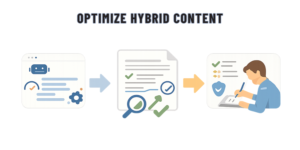
How to Optimize Hybrid Content for Maximum SEO Impact
Hybrid content combines AI speed with human insight-but it needs careful optimization to perform in search:
-
Structure for Readability:
Use headings, bullet points, and short paragraphs to facilitate scanning.
-
Integrate Semantic Keywords:
Let AI suggest keywords, but humans ensure they fit naturally.
-
Enhance Engagement:
Incorporate examples, visuals, and context to keep readers on the page longer.
-
Strengthen EEAT:
Human edits boost credibility, authority, and trust signals.
-
Update Regularly:
Refresh content with new insights or FAQs to maintain rankings.
Result: 80% AI output, guided by 20% human insight, produces content that ranks well and feels natural.
Why Human Creativity Still Matters in the Age of AI?
Even with AI doing most of the heavy lifting, human creativity remains crucial:
- AI Generates Ideas:
Outlines, keyword clusters, and draft paragraphs. - Humans Add Nuance:
Tone, examples, and actionable insights that AI cannot fully replicate. - Problem-Solving:
Humans refine content to answer user intent and complex queries. - EEAT Enhancement:
AI provides structure; humans add credibility and authority. - Engagement:
Humans ensure content resonates, keeping readers and Google happy.
The Bottom Line
As the line between Google and AI writers keeps shifting, one thing is clear heading into 2026: AI content alone won’t win-strategy will. Google isn’t penalizing AI content; it’s filtering out content that lacks purpose, depth, and real SEO intent. The brands that continue to rank are those that combine smart AI use with human insight, analysis of search behavior, and consistent optimization. That balance doesn’t happen by accident. It requires experience, testing, and a deep understanding of how AI content and SEO interact in practice.
Getting that balance right with AI content and SEO isn’t always easy, and that’s where Straction Consulting steps in. Based in Noida, Straction helps brands build search strategies that feel human, not mechanical-using AI where it adds efficiency and human expertise where it adds trust. If your goal is content that ranks today and still holds up in 2026, working with a team that understands both Google and AI makes all the difference.