SEO is not only about keywords, but it is a fundamental shift in how we think about search. The purpose of semantic search is to identify the user’s intent so that context can be provided. Determining the user’s intent and the semantics of words related to it helps provide useful results. Google’s Search Engine Results Pages (SERPs) provide recommendations for content, products, or videos within its recommended system. As an SEO, these changes are important because your rank is no longer based solely on the keywords you target but also on how closely your content aligns with your target audience. The blog further discusses semantic search for SEO and its impact on Search Engine Optimization.
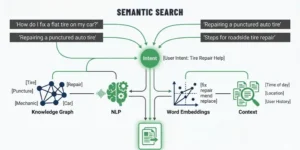
What is Semantic Search?
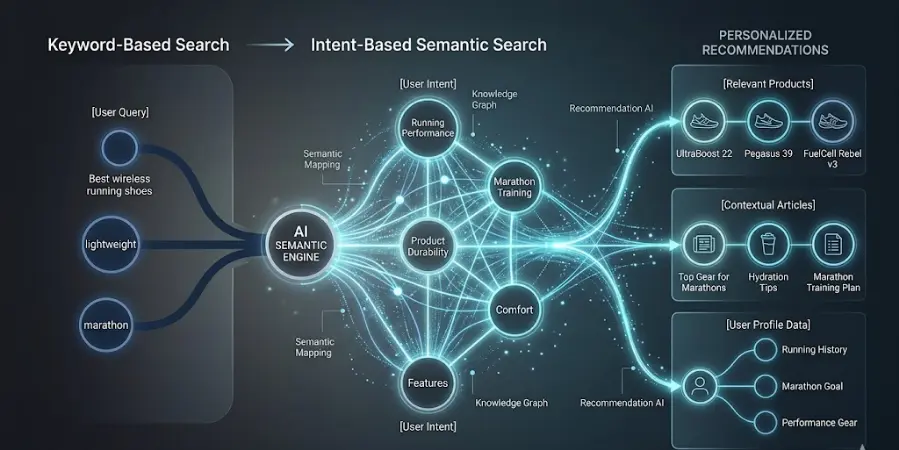
Semantic Search is a method of retrieving information by analyzing connections among words and concepts to infer the user’s intent, regardless of the exact words used. It is powered by Natural Language Processing (NLP) algorithms that transform human language into a machine-learning format, use vector embeddings to represent word relationships, and utilize knowledge graph technology to determine different words that represent the same idea. For example, the phrases ‘cost-worthy laptops’ and ‘budget-friendly computers’ represent the same general idea.
What are Recommender Systems?
Recommender Systems are designed to predict what users like to make suggestions for products, content, or services. When combined with semantic search, recommender systems can provide more contextual and personalized recommendations. For example, a recommender system can provide a movie recommendation based on a thematic analysis of the film, rather than on how the film fits into a particular genre.
How Semantic Search Impacts SEO
Search engines now evaluate how relevant your content is to users by utilizing their understanding of what they are trying to find when they type in a query. They are looking not just for the exact words you use but why you wrote that. This has changed the way search engines rank and display content. This means that to have an effective SEO strategy, you cannot simply insert keywords into your content; rather, you have to create content that answers users’ questions completely and includes related information.
Key Ways Semantic Search Impacts Your SEO
- Concentrate on Search Intent, Not Keywords
Your content must provide what users are searching for or want to know, as opposed to just giving them the words they typed in when searching. - Topic Clusters Are More Powerful Than Just Keywords
When a website provides deep coverage of an entire topic across many related pages, it ranks higher in search engine results than simply using a single keyword. - SEO Based on Entities
Because search engines now understand entities (such as people, products, places, concepts), your content should include items that relate to that entity. - Depth and Context of Content Influences Rankings
The better your content describes your topic with more detailed information, the more likely it is to rank higher. - Using Structured Data to Help Search Engines Understand Your Content
Using structured data or schema markup assists search engines in interpreting your content to improve visibility via the best results. - How Internal Linking Can Provide Topical Authority
Linking to related pages helps search engines understand your site’s hierarchical structure and establish expertise in the subject matter being written about.
Also Read: How to Handle Product Variations & Filters Without Duplicate Content
How Recommender Systems Impact Content Visibility
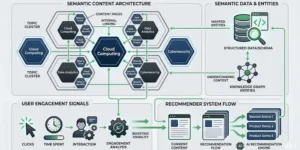
Recommender Systems are essential tools for determining which content is available to users across various digital platforms, such as e-commerce SEO sites, video platforms, and websites. Recommender Systems use past user data (clicks, time spent viewing, time spent reading, and interactions) to recommend relevant content based on your habits. For SEO and content creators, this allows both user engagement and user behaviour to inform content visibility, rather than just its ranking.
Key Ways Recommender Systems Impact Content Visibility
Here are some key ways how Recommender Systems Impact Content Visibility:
- User Activity Affects How Much Content is Dispersed
Content has better chances to be presented to other users when there are higher click-throughs, longer time on the page, or more interactions on the content - Tailoring Content to What People Want to See
Regularly updating content can improve the chances of appearing in recommendations and suggested content sections. - Using Internal Links to Gain More Recommendations for Your Content
Related or recommended articles, and content widgets assist platforms in defining connections between pieces of content and how they relate to one another, which helps increase their visibility. - Using Fresh or Updated Content to Gain More Recommendations
The more frequently you refresh your content, the better the chances it will be included among recommendations and in suggested areas. - Quality of Content and Relevance are Important
Content that meets user needs, has a low bounce rate, and encourages further browsing ranks highly. - Content that is Less in Text and more in graphics ranks higher
Pages with video, photo, infographic, or interactive content perform better than pages that contain only text in recommendation systems.
SEO Strategies for Semantic Search & Recommendations
To compete in today’s search market, SEOs must optimize not just ranking factors but also other criteria, such as relevancy, context, and user engagement. Your strategy should align with how semantic search and recommender systems operate to increase visibility across platforms.
Key SEO Strategies to Implement:
1) Focus On Search Intent
Identify if a searcher is looking for content, making a purchase, or comparing products, and create content that would satisfy the searcher’s intent.
2) Use Entities and Associated Terms
Incorporate synonyms, related concepts, and entities (people, brands, and topics) into your content to make it more informative and help search engines understand it.
3) Build Topical Authority
Create high-quality content around a subject with related topic clusters, pillar pages, and linking of articles, to ultimately develop experience.
4) Improve UX & Engagement Signals
Optimized page load times, readability, and structure/design improve dwell time and decrease bounce rates, ultimately encouraging interaction.
5) Use Schema Markup
Implement structured data markup to help search engines interpret content, which could improve organic search results through snippets and featured results.
Also Read: EEAT Optimization: Practical Ways to Prove Expertise
Final Thoughts
SEO has evolved in an amazing way over time. In the past, it was just about optimizing keywords. However, now it has changed into optimizing topics and understanding the intent of the searchers. This helps people search more effectively and supports search engines and other platforms in understanding user behavior.
Today, a website’s visibility isn’t just based on its position in the search results; it also requires a good level of engagement to keep users on the page. Hence, SEO success today relies on relevance, engagement, and authority rather than solely relying on keywords. With Straction Consulting, one of the best content creation services agencies in India, you can create intent-driven, SEO-optimized content and strategies to boost the relevance and engagement of your website for long-term visibility. For details contact us at +91 9810430573.